

Looking Beyond Cholesterol Numbers
- Nadia Kawash
- Blood Pressure, Body
Before the summer break, we continued our Heart Health series by exploring some of the newer cardiovascular markers that are helping us look beyond cholesterol alone. This month, I’d like to take that one step further…
I hope you’ve all had a wonderful summer and found time to rest, recharge, and enjoy time with family and friends.
I took a short pause over August, and I’m excited to be back.
Before the break, we began a conversation about something that is changing rapidly in medicine…
We discussed how cholesterol is no longer viewed as one isolated number, but rather as one piece of a much bigger picture involving inflammation, blood sugar, metabolic health, genetics, lifestyle and cardiovascular risk.
If you missed that newsletter—or simply need a refresher—you can always find it HERE or on my website.
This month I’d like to build on that conversation…
One of the biggest changes happening in cardiovascular medicine today is the recognition that cardiovascular risk cannot be judged by cholesterol alone.
For many years, people were often reassured or treated based mainly on standard cholesterol results. But newer prevention models are beginning to recognize that cardiovascular disease is far more complex and influenced by many interconnected factors.
This is why conversations around prevention are evolving.
Today, doctors and prevention-focused practitioners are looking more closely at the individual sitting in front of them — their genetics, metabolic health, inflammation levels, lifestyle, family history, plaque burden, and overall cardiovascular risk profile.
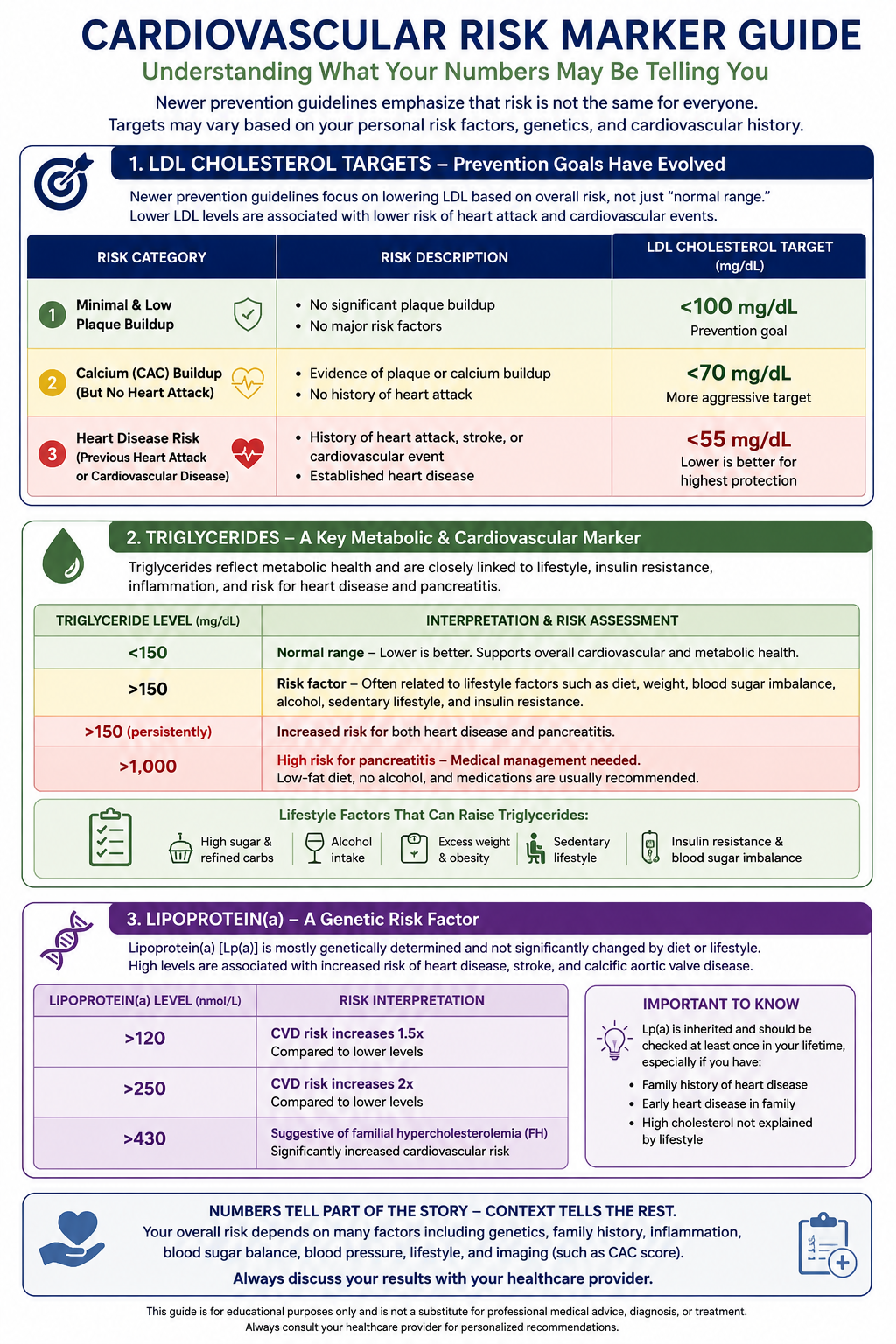
For example, someone who has already experienced a cardiovascular event, has diabetes, elevated Lipoprotein(a), plaque buildup, or significant family history may be considered higher risk and therefore may be advised to aim for more aggressive cardiovascular targets than someone considered lower risk.
The goal isn’t simply to lower cholesterol. The goal is to reduce the likelihood of plaque progressing, stabilize existing plaque when present, and lower the long-term risk of heart attack or stroke based on an individual’s overall risk.
The infographic below illustrates how current cardiovascular guidelines from organizations such as the American Heart Association (AHA) and American College of Cardiology (ACC) are becoming increasingly personalized according to an individual’s overall level of risk.
Rather than asking:
“What is the normal cholesterol range?”
The question is increasingly becoming:
“What is the safest and most protective range for this individual based on their personal risk profile?”
This is an important distinction.
Because two people can have identical cholesterol numbers on paper while carrying very different cardiovascular risk beneath the surface.
This is also why more advanced testing is becoming increasingly important in prevention-focused medicine.
Markers such as ApoB, Lipoprotein(a), inflammation markers, insulin resistance markers, triglycerides, and Coronary Artery Calcium (CAC) scoring may help provide a more complete picture of cardiovascular health and help guide earlier intervention when needed.
This is where Functional Medicine and personalized prevention often overlap. Rather than focusing on one number, we look at how these markers interact with inflammation, metabolism, hormones, nutrition, lifestyle, genetics and symptoms to understand the whole picture.
Those patterns may reflect chronic inflammation, blood sugar imbalance, poor sleep, nutrient deficiencies, chronic stress, sedentary habits, smoking history, or metabolic dysfunction developing quietly over time. The encouraging part is that many of these factors may be modifiable long before more advanced disease develops.
This is why prevention matters so much.
Not because we want people to become fearful of disease — but because understanding patterns earlier may create the opportunity to support the body sooner through nutrition, movement, sleep, stress reduction, metabolic support, and lifestyle changes that can have profound long-term impact.
Health is rarely static, and prevention is no longer simply about reacting to disease after it appears.
It is about understanding the individual more deeply before the body reaches that point.
Curious About Your Own Numbers?
Reading about these markers is one thing…
Understanding what your blood tests are saying is another.
Many people are told their results are ‘normal’ yet continue to struggle with:
- Weight that won’t shift
- Fatigue
- High cholesterol
- Elevated triglycerides
- Blood sugar changes
- Inflammation
- Hormonal changes
- Digestive issues
Often the answers lie not in one isolated result, but in the overall pattern.
As a Functional Medicine Practitioner, I help people look beyond ‘normal’ to understand how their blood tests, lifestyle, nutrition, metabolism and symptoms fit together.
Sometimes small changes can make a surprisingly big difference.
The earlier we can identify risk, the greater the opportunity to change its course.
If you’ve recently had blood work done and would like to understand what it may be telling you beyond the ‘normal’ ranges, I’d be happy to help.
Book an Initial Functional Medicine Consultation…
Always looking out for you,
Small changes for a healthier “U”