

Could High Cholesterol and High Blood Sugar Both Be Connected to Metabolic Dysfunction?
- Nadia Kawash
- Blood Pressure, Body, Sugar
Over the past few months, I have really focused on cholesterol.
And there is a reason for that.
I wanted you to understand that cholesterol is no longer simply about looking at one LDL number on your blood test and deciding whether it is “high” or “normal.”
Research and prevention guidelines are changing the way we look at cardiovascular health. We are beginning to understand much more about cholesterol particles, inflammation, blood sugar, insulin resistance, genetics, lifestyle and the many other factors that can influence our risk.
Most importantly, I want you to become more proactive with your health, rather than waiting for something to go wrong.
There is one last part of this conversation that I would like to discuss.
STATINS.
There is a very good chance that if you have elevated cholesterol, you have either been prescribed a statin or had a conversation with your doctor about taking one.
For some people — particularly those who already have cardiovascular disease or are at high cardiovascular risk — statins can be lifesaving and are an extremely important preventative treatment.
But there is another part of the conversation that I don’t think many people are aware of.
What effect can statins have on your blood sugar?
This is worth understanding.
Research has shown that statins can cause a small increase in blood glucose and may slightly increase the risk of developing Type 2 diabetes.
This is particularly relevant for someone who is already at higher risk of developing diabetes — perhaps because they already have insulin resistance, elevated fasting glucose, prediabetes, excess abdominal fat or other metabolic risk factors.
In other words, a statin doesn’t mean that someone will suddenly develop diabetes.
But if blood sugar is already moving in the wrong direction, this is another reason why we should be monitoring it and, more importantly, working on the metabolic health underneath it.
That does not mean statins are bad.
And please do not misunderstand what I am saying.
I am certainly not suggesting that anyone stop taking a statin or avoid one when it is medically necessary.
For someone at significant cardiovascular risk, the cardiovascular benefits of statin therapy can far outweigh the relatively small increase in diabetes risk.
But it raises an important question:
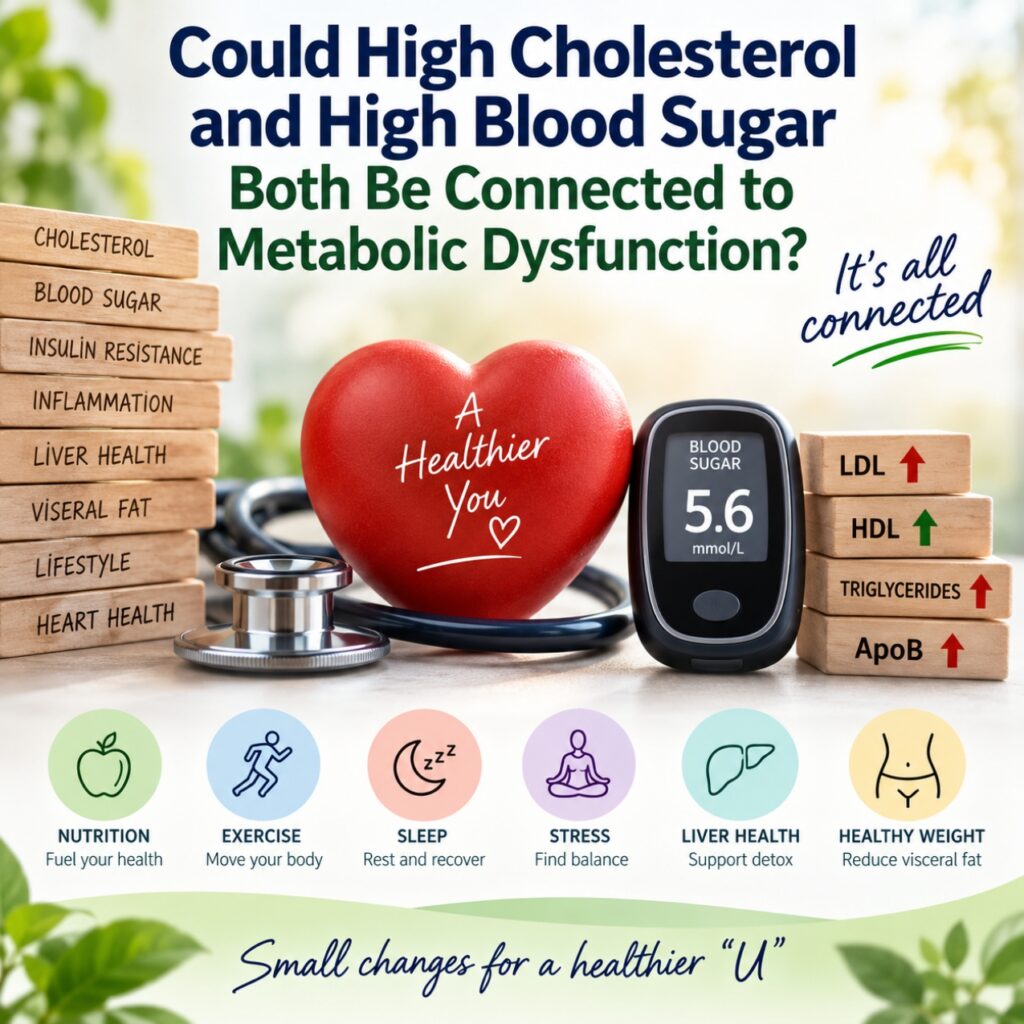
If high cholesterol and high blood sugar are both connected to metabolic dysfunction, shouldn’t we also be addressing the metabolic problem?
So What Is Metabolic Dysfunction?
Very simply, metabolic dysfunction means that the systems responsible for managing blood sugar, insulin, fats and energy are no longer working as efficiently as they should.
Over time, we may begin to see:
- Rising fasting glucose
- Higher insulin levels or insulin resistance
- Increasing triglycerides
- Changes in cholesterol
- Stubborn abdominal or visceral fat
- Fatty liver
- Higher blood pressure
- Increased inflammation
- Difficulty losing weight
And very often, these changes do not happen independently.
They are connected.
This is why cholesterol should never be looked at in a vacuum.
Insulin resistance, elevated blood sugar, inflammation, excess visceral fat, poor nutrition, inactivity, poor sleep, chronic stress, liver health and other metabolic factors can all influence your lipid profile and your overall cardiovascular risk.
So if we simply see an elevated LDL cholesterol and think:
“Let’s lower the number.”
…we may be missing a much bigger story.
Medication may lower LDL very effectively, but it doesn’t automatically correct the lifestyle and metabolic factors that may be contributing to the problem in the first place.
Look at the Bigger Picture
What is happening with your blood sugar?
What is your fasting insulin telling us?
What are your triglycerides doing?
Is there inflammation?
What does your waist circumference or visceral fat look like?
How is your liver functioning?
What are you eating?
Are you exercising?
How well are you sleeping?
And what do the more advanced cardiovascular markers we discussed in my previous newsletters — such as ApoB, Lipoprotein(a), triglycerides, high-sensitivity C-reactive protein and other metabolic markers — tell us about your actual risk?
These questions matter.
Something I notice quite often when speaking with people taking cholesterol medication is that once their cholesterol number improves, they feel that the problem has been dealt with.
“My cholesterol is lower now, so I’m fine.”
And life continues exactly as before.
The same food.
The same habits.
The same lack of exercise.
The same abdominal weight.
The same high blood sugar.
But lowering one number does not necessarily mean that everything happening underneath has changed.
A statin can lower your cholesterol. It cannot exercise for you, improve your diet for you, build muscle for you, improve your sleep or reverse the lifestyle factors contributing to poor metabolic health.
That part still belongs to us.
And this is the message I really want you to take away from this entire cholesterol series.
Medication and lifestyle do not have to be an either/or conversation.
For many people, the best approach may be both.
Use medication when it is medically appropriate and at the same time work on improving the health of the body underneath those numbers.
Nutrition.
Blood sugar balance.
Insulin sensitivity.
Exercise and muscle mass.
Sleep.
Stress.
Inflammation.
Liver and metabolic health.
Weight and visceral fat.
And appropriate cardiovascular testing.
Statins can also cause side effects in some people, including muscle aches or weakness. If you experience symptoms, speak with your doctor rather than simply stopping the medication yourself. Sometimes the dose or type of statin can be adjusted.
And if improving your metabolic health significantly changes your cardiovascular risk and cholesterol profile over time, that is a conversation you can have with your doctor about what medication and dose remain appropriate for you.
The goal should never simply be to get off medication.
The goal is to become healthier.
If medication remains necessary to protect you, then it is doing an important job.
But alongside it, we should still be asking:
What can I change today that improves my health five, ten or twenty years from now?
That is what being proactive about your health really means.
A Welcome Back From Summer Offer
If you are concerned about your cholesterol, blood sugar, insulin sensitivity or metabolic health — and you genuinely want to understand what your blood tests are telling you and start making meaningful changes — I would like to offer you something special this month.
For a limited time, I am offering 50% OFF my consultation fee as a Welcome Back From Summer offer.
I will review your blood tests in detail, look at the patterns rather than simply individual numbers, and create an action plan showing you where you may need to focus your attention.
We will look at your cardiovascular markers, blood sugar and insulin balance, inflammation, nutrition, lifestyle and metabolic health and begin putting the pieces together.
The offer ends October 16th.
If you have been meaning to take your health more seriously, perhaps this is your opportunity.
Don’t wait until your numbers become a diagnosis.
Own your health.
Understand your numbers.
And make the changes today that can help you become a healthier version of yourself.
Always looking out for you,
Small changes for a healthier “U”
References / Further Reading
American Diabetes Association. Standards of Care in Diabetes—2026: Prevention or Delay of Diabetes and Associated Comorbidities.
American Diabetes Association. Standards of Care in Diabetes—2026: Cardiovascular Disease and Risk Management.
Cholesterol Treatment Trialists’ Collaboration. Effects of statin therapy on diagnoses of new-onset diabetes and worsening glycaemia in large-scale randomised blinded statin trials. The Lancet Diabetes & Endocrinology, 2024.